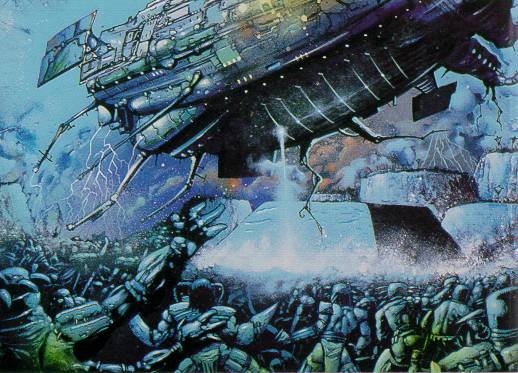
A sprawling battle scene rendered in cool, moonlit blues, dominated by an enormous armoured warship or flying fortress descending on a beam of light directly into the middle of a packed battlefield. Below, a dense crowd of blue-armoured troops raise their hands and weapons toward the sky in shock as the vessel's arrival splits the clouds with jagged bolts of lightning, smoke and fire boiling up around the point of impact. The ship itself is a marvel of Bisley's design work, bristling with antennae, hull plating and glowing lights, floating with genuine mechanical weight despite the otherwise painterly, almost impressionistic rendering of the crowd beneath it. The composition uses classic diagonal thrust, the ship cutting down from the upper left while the mass of soldiers surges up from the lower right, their raised arms and weapons creating a visual current that meets the descending light at the centre of the frame. This kind of large-scale science-fiction spectacle sits comfortably alongside the genre work Bisley became known for at 2000 AD after 1987, where stories demanded both intimate character painting and vast, world-shaking set pieces within the same run. The title's promise of surprise for the blue army is delivered entirely through staging and scale rather than facial expression, the tiny human figures dwarfed by the impossible machine arriving among them, an effective way of conveying the shock of the moment without a single line of dialogue.
 The blue army gets a surprise